

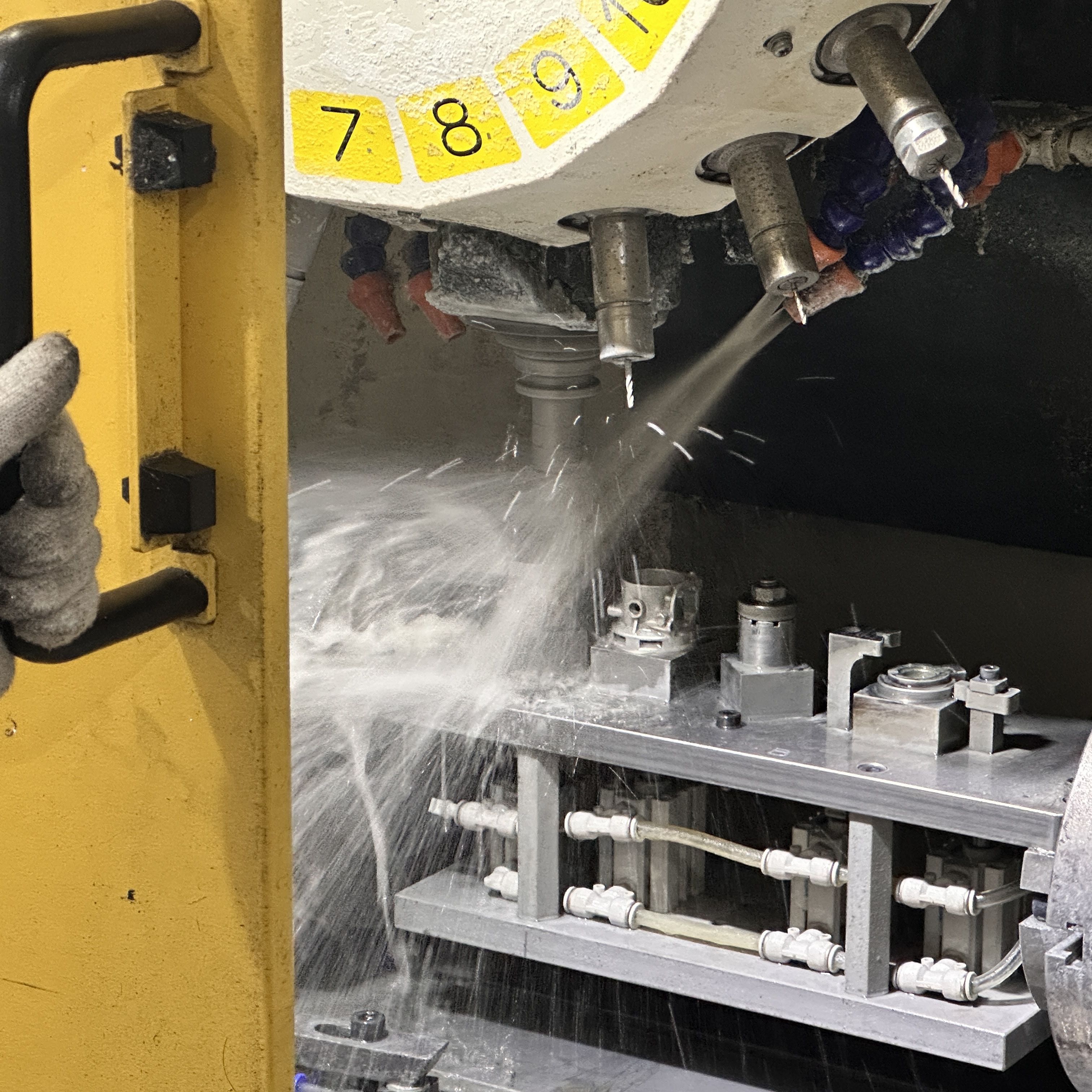
"How much does this part cost to machine?" is usually the first question on a request for quotation, and it is the hardest one to answer honestly with a single number. The cost of a machined part is not one number; it is six or seven blocks of cost stacked on top of each other, and the mix shifts with every drawing, alloy and quantity. This article walks through those blocks one by one, shows how they combine at different order sizes, and gives you a way to read a quote so you can see what you are actually paying for.
The cost blocks inside every machining quote
Strip any machining quotation down to its logic and the same blocks appear. The proportions below are typical ranges for aluminium and steel parts in the small-to-medium size class — treat them as orientation, not as a fixed rule, because a single drawing can move any block by ten points in either direction.
| Cost block | What it covers | Typical share | What moves it most |
|---|---|---|---|
| Material | Raw stock, material certification, scrap removed by cutting | 20–40% | Buy-to-fly ratio, alloy family |
| Machine time | Cutting on the machining centre or lathe | 20–40% | Cycle time, tolerances, complexity |
| Setup & programming | CAM programming, fixture preparation, first-piece prove-out | 10–30% on short runs | Number of setups, order quantity |
| Tooling & fixtures | Special cutters, custom jigs, amortised over the order | 5–15% | Non-standard features |
| Finishing | Anodising, plating, coating, masking | 5–20% | Number of finishing steps |
| Inspection & documents | Critical-dimension checks, reports, certificates | 5–15% | Number of critical features |
Two conclusions fall straight out of this table. First, machine time — the block everyone fixates on — is rarely more than half the price. Second, several of the blocks are fixed costs that do not care whether you order one part or five hundred, which is why quantity changes the picture so dramatically. We will come back to that in the worked example.
Material: the bar you buy is bigger than the part you weigh
The most misunderstood line in machining cost is material, because buyers compare the weight of the finished part against the market price of the metal and conclude the number should be small. The gap between those two figures has three causes.
Buy-to-fly ratio. A part that weighs 150 grams may have to start from a 1.2-kilogram block or billet, because the stock must be oversized on every face for clamping, and the machining removes the rest. On complex parts the finished part can be a fifth or less of the raw stock, and the scrap is not free — it was purchased at full price even if a fraction of its value comes back as recycling credit.
Stock sizes and minimum orders. Plate, bar and billet come in fixed thicknesses and diameters. A part whose largest dimension is 31 mm may force the purchase of 40 mm stock, buying thickness nobody uses. And mills sell in minimum quantities: a first batch of fifty parts can carry the burden of a full stock length that later batches inherit.
Certification. Certified material with a mill test report costs more than commercial-grade metal of the same alloy, and for industries where material traceability matters, that premium is not optional. The honest way to compare quotes is to check that both suppliers assumed the same material specification and the same certificate level, not just the same alloy name.
Machine time: the number everyone fixates on and nobody can benchmark
Buyers love asking for an hourly machine rate because it feels like a benchmark. In practice it compares almost nothing. Two shops can quote the same nominal rate and still be 30% apart on the part price, because what you are buying is cycle time × rate × first-pass yield, and the rate is the only one of the three that is visible on the quote.
Cycle time is driven by the drawing. Tolerances are the biggest lever: a feature held at ±0.1 mm cuts at full feed, while the same feature at ±0.02 mm may need finishing passes, slower feeds, and in-process measurement — and if the tolerance sits near what the machine can reliably hold, cycle time climbs again while yield drops. Depth of pockets, thin walls, tool changes and bore counts all add to it. Our earlier note on what CNC accuracy really means explains why a tolerance that is easy on one machine can be expensive on another.
This is also why a machine-hour comparison across industries misleads: the CNC machining shop cutting open-tolerance brackets and the one finishing thin-walled housings may run the same class of equipment, but the seconds per part are not in the same universe.
Setup and programming: the fixed cost that decides small-batch pricing
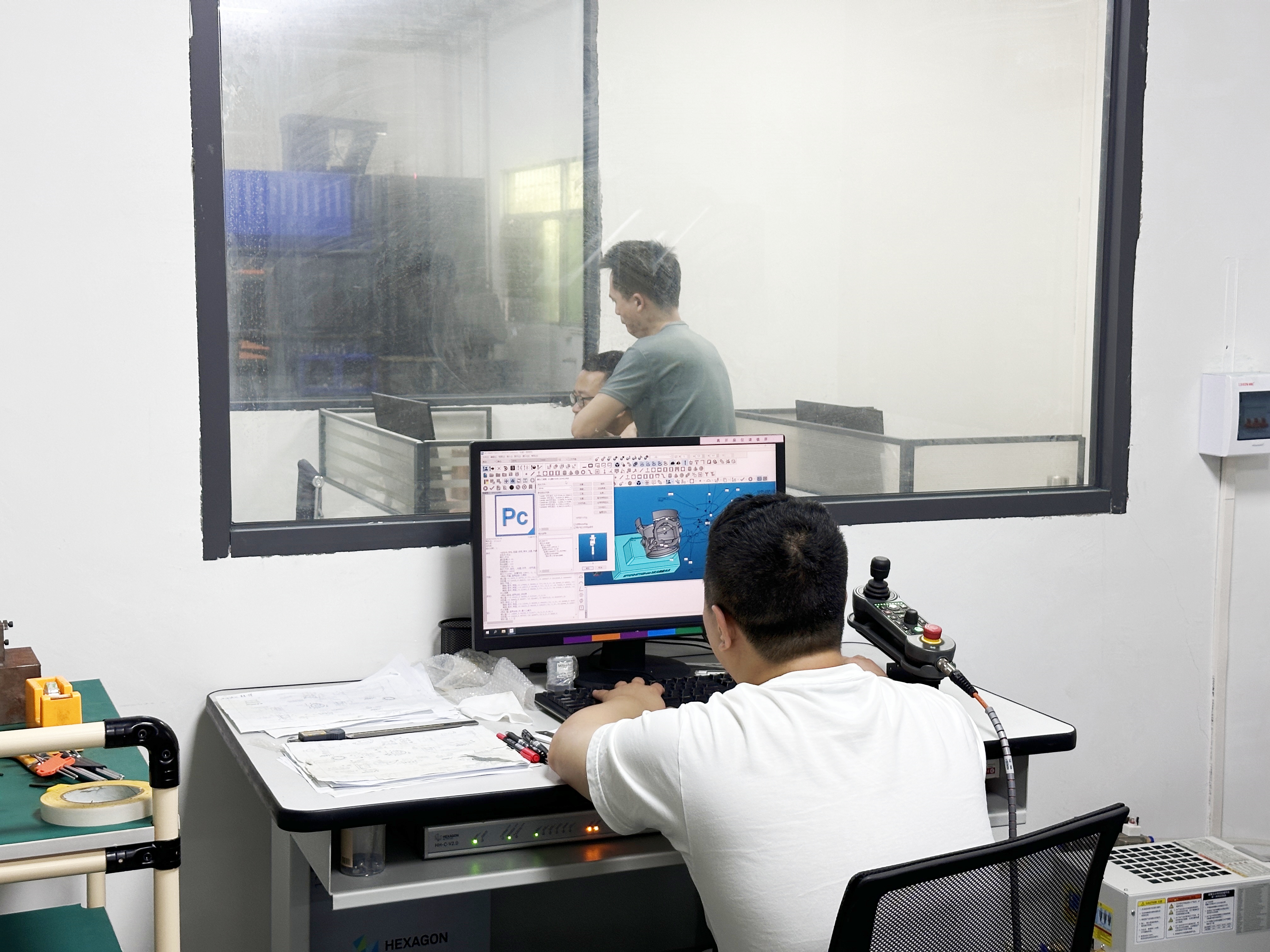
Before a single production part is cut, the part exists as engineering hours: CAM programming, work-holding design, tool selection and a first-piece prove-out that confirms the program runs and the dimensions land. None of this scales with quantity. Whether the order is for one part or one thousand, those hours are the same — so on a one-piece order they may dominate the price, while on a thousand-piece order they nearly vanish.
The number of setups matters as much as the hours. Every time a part leaves the machine to be re-clamped, the shop pays for fixturing, re-referencing and a little accumulated error risk. A part designed so that most features can be reached in two or three setups is cheaper than an almost identical part that needs five or six, and the difference shows up mostly on short runs where setup is a large share of the total.
Tooling, fixtures and first articles
Standard end mills and drills are part of the shop's overhead. What shows up as separate lines are the non-standard items: form tools, special reamers, dedicated jigs for awkward geometry. These are usually quoted as a tooling charge, either as a one-time fee or amortised into the unit price over an agreed quantity — and it is worth knowing which, because it changes how a price behaves when you reorder. A quote with a separate tooling line is transparent but front-loaded; an amortised quote looks cheaper on the first order and assumes you will reach the agreed quantity.
First article inspection sits in the same family: a one-time, per-revision cost that becomes its own line when the buyer asks for a documented first article report. On programmes where revisions are frequent, the first-article cost recurs more often than buyers expect, which is one of the quiet reasons revision-heavy projects cost more than their unit prices suggest.
Finishing and inspection: the lines buyers forget to budget
Finishing is rarely the biggest block, but it is the one most often omitted from a buyer's mental model. Anodising, plating and coating are batch processes with their own minimum charges — a small order of parts can carry a disproportionate finishing cost because the bath ran regardless. Masking threads and critical bores before coating adds handling time. And a finish changes dimensions by a predictable but non-zero amount, so features that must stay final after coating need masking or machining offsets agreed on the drawing. Our overview of how surface finishing changes part performance covers the cost and tolerance side of that decision.
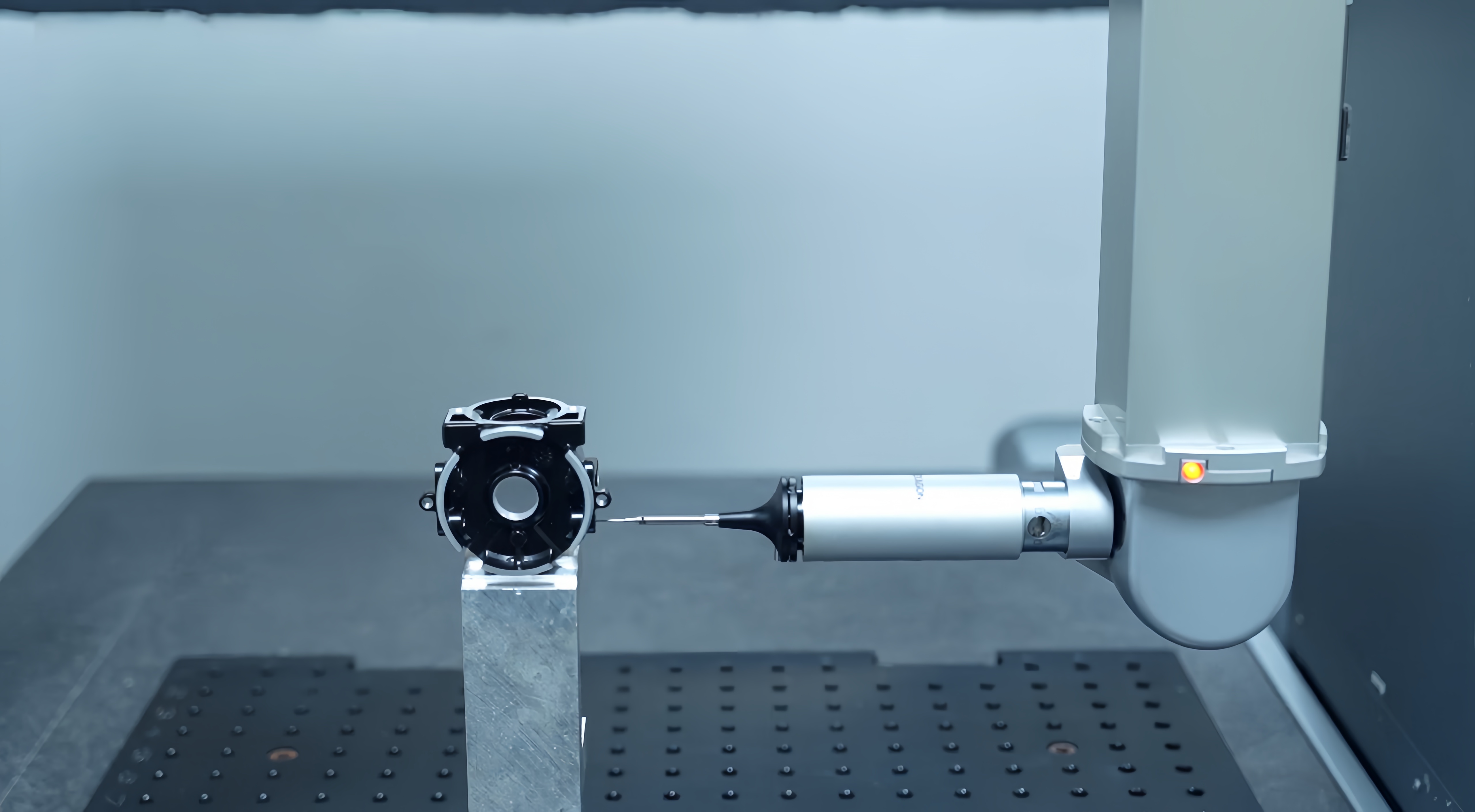
Inspection cost follows the same logic of depth versus breadth. A shop can gauge-check every part cheaply and CMM-sample occasionally, or CMM every critical dimension on every part — both are legitimate strategies, but they are not the same price. What matters is that the inspection plan matches the drawing's critical features, and that the documentation you receive — dimensional reports, material certificates, certificates of conformity — is the package you actually need. If you are unsure how far to go, our article on metal part quality inspection outlines the common levels.
A worked example: one bracket, three quantities
To make the cost blocks concrete, consider a representative part: a 6061-T6 aluminium mounting bracket, roughly 120 × 80 × 30 mm, two precision bores, standard surface finish, moderate tolerances overall with two tight features. The table below shows how the cost structure shifts as quantity grows. Unit costs are indexed with the quantity-1 price set at 100, because absolute figures depend on region and market conditions — the shape of the curve is what carries the lesson.
| Quantity | Unit cost index | Dominant cost block | What is happening |
|---|---|---|---|
| 1 | 100 | Setup & programming | Engineering hours spread over one part; material and cutting are minor |
| 50 | ≈18 | Machine time | Setup amortised; cycle time and material now dominate |
| 500 | ≈9 | Material + machine time | Fixed costs nearly gone; price approaches the physics of cutting and metal |
Three things are worth noticing. The fall from 1 to 50 units is enormous — the fixed-cost block is being divided into more parts. The fall from 50 to 500 is much gentler, because by then you are paying mostly for cutting time and metal, which do not shrink with quantity. And the curve never flattens to zero: there is a floor set by material and cycle time that no order size can break. Buyers who understand this shape stop asking "why is one piece so expensive?" and start asking the more useful question — "at what quantity does this part stop being a machining job and become a casting or stamping job?" That crossover is a separate decision with its own economics, outlined in our comparison of CNC machining versus die casting.
Why two quotes for the same drawing differ by 40%
When the same drawing returns quotes 40% apart, the difference is rarely one shop being inefficient and the other being generous. More often, the two suppliers priced different jobs, because the drawing left assumptions open:
- Starting stock. One supplier assumed machining from plate; the other priced a near-net blank that removes hours of cutting.
- Number of setups. A four-setup plan and a two-setup plan are different prices for the same geometry.
- Finish scope. "Anodised" can mean every face, visible faces only, or bores masked or unmasked.
- Inspection depth. Full CMM on every part versus sampling plans are different products.
- Yield and rework allowance. A shop that has run similar geometry before prices less contingency than one that has not.
The practical defence is to ask each supplier to state these assumptions in writing with the quote. The questions worth asking — and the ones a reliable supplier will welcome — are listed in our guide to the questions to ask before choosing a metal parts manufacturer. A 40% gap with visible assumptions is information; a 10% gap with none is a risk.
How to read a machining quote line by line
Before comparing two quotes on price, read each one for what it actually commits to. A short checklist:
- Unit price and validity. At which quantity, for how long, and does it change at other quantities?
- Material specification. Alloy, temper, certificate level — written out, not just "aluminium".
- Setups and process route. How many clamping positions, and which machines.
- Finish per face. Type, thickness or colour class, and what is masked.
- Inspection method for critical dimensions. CMM every part, sampled, or gauge-checked.
- Documentation included. Dimensional report, material certificate, certificate of conformity — in the price or extra.
- Tooling treatment. Separate charge, amortised, and who owns the fixture afterwards.
Quotes that answer these seven points cleanly are comparable. Quotes that do not are cheaper for a reason you have not found yet — and the reason usually surfaces after the purchase order, when it is expensive. Our longer guide on choosing a CNC machining manufacturer extends this checklist to the supplier as a whole.
Questions buyers ask about machining cost
Why is the price for one piece so much higher than the per-unit price at quantity?
Because setup, programming and first-article work are fixed costs. On a one-piece order they are carried entirely by that part; at higher quantities they are spread. The unit price at quantity 1 is not a markup — it is the true cost of making one part from scratch.
Can you just quote me your machine rate per hour?
An hourly rate without a cycle time and a first-pass yield does not describe a part. Two suppliers with identical rates can be 30% apart on final price depending on process planning. It is more useful to compare complete part quotes with stated assumptions.
Which design changes reduce machining cost the most?
Usually, in order of impact: reducing the number of setups, relaxing tolerances on non-functional features, using standard tool radii, avoiding deep narrow pockets, and choosing a stock size that matches the part's largest dimension. Most of these cost nothing functionally and everything financially.
Does a tighter tolerance always mean a higher price?
Only when it crosses a process threshold — where the shop must slow down, add finishing passes or change inspection method. A tolerance tightened from ±0.1 mm to ±0.05 mm may cost nothing extra on many features; the same move from ±0.02 mm to ±0.005 mm can double cycle time and add measurement cost. The relationship is a staircase, not a slope.
Have a drawing and a target cost?
Send us the part, the quantity and the annual volume. We will come back with a quote that shows its assumptions — stock, setups, finish scope and inspection depth — so you can see what you are paying for before you commit.
Request a Machining Quote