

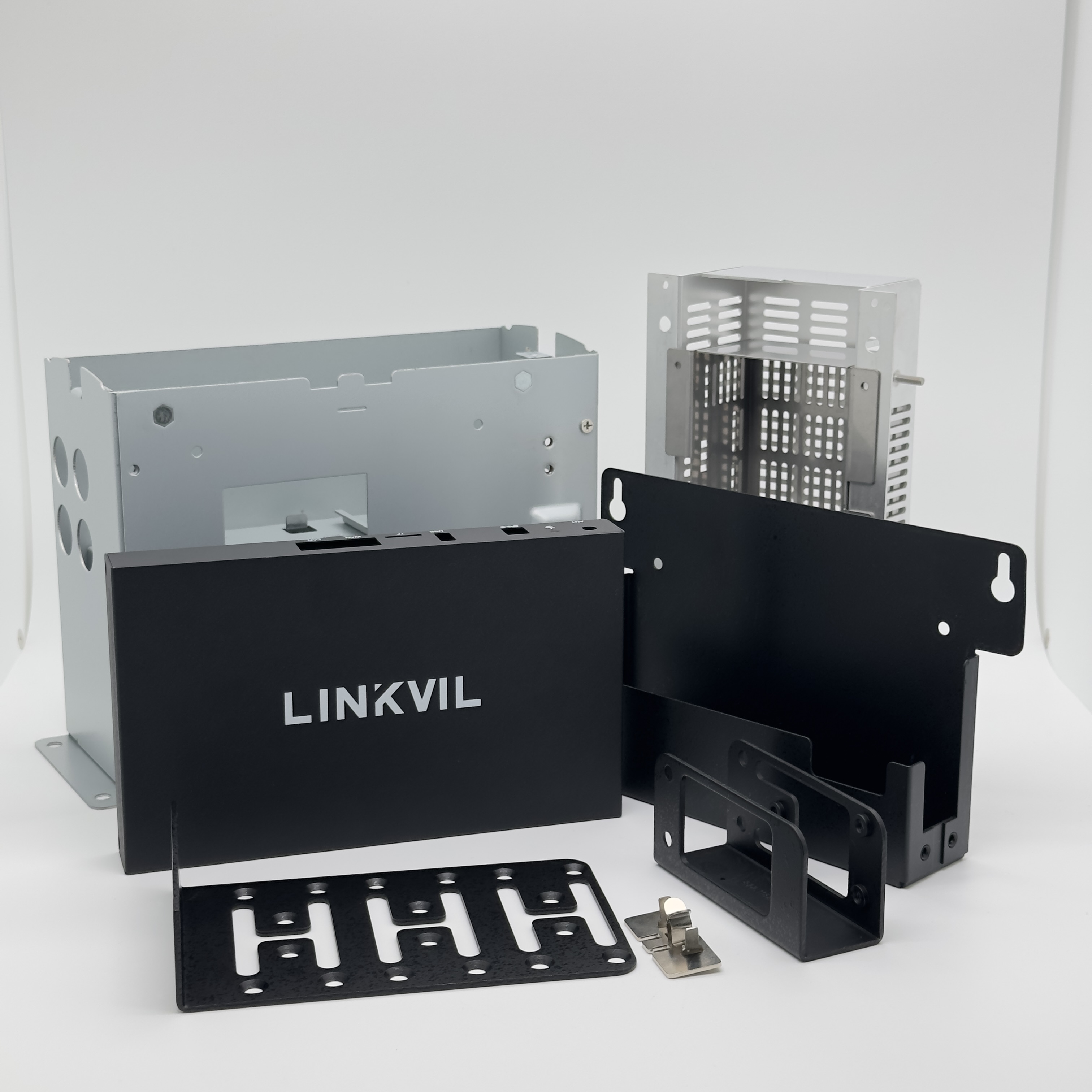
Choosing the right manufacturing process affects part cost, weight, structural performance, dimensional accuracy, production time, and scalability. For custom metal parts, two processes are considered most often: sheet metal fabrication and cnc machining. Both can produce high-quality components, but they approach a design from opposite directions. Sheet metal fabrication forms thin or plate-based material through cutting, bending, forming, welding, and related operations. CNC machining removes material from a solid workpiece using computer-controlled cutting tools.
That difference shapes everything that follows. A part designed as a bent enclosure is usually inefficient to cut from solid stock, while a part with internal pockets and tight bores cannot be produced by folding sheet. Deciding between sheet metal fabrication vs CNC machining therefore comes down to the part's geometry, material, thickness, tolerances, production volume, and functional requirements — not to which process is inherently superior.
This guide explains how each process works, compares them factor by factor, and gives a practical framework for choosing one, the other, or a combination of both.
What Is Sheet Metal Fabrication?
Sheet metal fabrication builds a component from flat stock — sheet or plate — by cutting it to a blank and then forming it into shape. The core operations are laser or CNC cutting, punching where applicable, bending, forming, welding, and assembly, followed by surface finishing. Because the starting material is already close to the final wall thickness, the process creates structure rather than removing material.
Its natural products are enclosures, panels, brackets, cabinets, covers, chassis, frames, and mounting plates — parts whose function is largely defined by flat surfaces, bends, and flanges. SUNPREC's sheet metal capability covers cutting, bending, forming, and surface treatments, and supports aluminum, stainless steel, and carbon steel. For a wider view of the process and its industrial uses, see this overview of custom sheet metal fabrication.
What Is CNC Machining?
CNC machining is subtractive: it starts with a solid workpiece — bar, block, plate, or casting — and removes material along programmed toolpaths until the part matches the CAD model. The main operations are CNC milling, cnc turning, drilling, threading, and multi-axis machining, which handles angled and curved features in fewer setups.
The process suits complex 3D geometry, precision holes, threads, pockets, slots, contoured surfaces, and tight-tolerance features — the kind of features that cannot be produced by cutting and bending. Typical parts include precision housings, mechanical blocks, shafts, fixtures, mounting components, and complex brackets. See precision CNC machining for a fuller process overview and CNC machining capability for the equipment side.
Sheet Metal Fabrication vs CNC Machining: Key Differences
| Factor | Sheet Metal Fabrication | CNC Machining |
|---|---|---|
| Starting material | Sheet or plate | Solid stock |
| Main processes | Cutting, bending, forming | Milling, turning, drilling |
| Best suited for | Thin and plate-based structures | Solid and complex machined parts |
| Material utilization | Often efficient for formed parts | More material removed as chips |
| Complex 3D geometry | Limited by forming and tooling | Highly flexible |
| Tight machined features | Limited | Excellent |
| Prototype flexibility | High | High |
| High-volume production | Suitable for many formed parts | Suitable depending on geometry |
| Tooling | May require forming tools by process | Generally lower dedicated tooling |
| Typical products | Enclosures, brackets, panels | Housings, blocks, shafts |
Three points deserve emphasis. First, the starting material usually decides the process: if the design is fundamentally a folded or flat component, forming is natural; if it is a machined body, machining is natural. Second, tooling economies differ: bending and punching may involve forming tools whose cost scales with volume, while machining generally needs only workholding and cutting tools. Third, the two processes are complementary rather than exclusive — a fabricated enclosure routinely receives machined components, and the sections below show where that combination pays off.
When Should You Choose Sheet Metal Fabrication?
Sheet metal fabrication is usually the natural choice for thin metal parts and for structures built from flat material. Typical products include enclosures, panels, brackets, cabinets, covers, chassis, frames, mounting plates, and other structural sheet components.
Material Thickness
If the part is itself defined by its sheet or plate thickness, fabrication is the obvious route — the material is already the right gauge, so no bulk removal is needed.
Bending Requirements
Designs built around bends, flanges, folds, and tabs are generally produced faster and more economically by forming than by machining. The more the design relies on folding to create stiffness, the stronger the case for fabrication.
Large Surface Areas
For large flat or bent structures, fabrication is often far more material-efficient than machining the same component out of solid block, where most of the plate would end up as chips. Fabricated sheet structures are also frequently used where lightweight, high-efficiency assemblies matter, as covered in this look at sheet metal fabrication for lightweight assemblies.
When Should You Choose CNC Machining?
CNC machining becomes the more appropriate route when the functional features of the part cannot be produced efficiently by cutting and bending. The clearest signals are complex 3D geometry, deep pockets, precision holes, threads, tight tolerances, contoured surfaces, multiple machining orientations, and parts that are solid by nature rather than formed from sheet.
Typical parts include precision housings, mechanical blocks, shafts, fixtures, mounting components, complex brackets, and other precision components where fit and function depend on machined accuracy. A practical illustration of how machining is compared against another forming process is available in this guide to choosing a manufacturing process.
Sheet Metal Fabrication vs CNC Machining for Different Part Geometries
Geometry is the fastest way to narrow the choice. Working through the common shapes:
Flat Panels
Sheet metal fabrication is usually suitable; a flat panel with cutouts is a cutting job, not a machining job.
Bent Brackets
Bent brackets are typically most efficient when formed from sheet, provided the required tolerances on holes and angles are achievable by the chosen bending process.
Enclosures
Enclosures are a classic fabrication application: folding creates rigid walls from thin material at low weight and reasonable cost.
Solid Blocks
Where the part is a solid body, CNC machining is generally more appropriate — there is no sheet to form, and the features are cut rather than folded.
Complex 3D Components
Machining may provide greater geometric flexibility for sculpted surfaces and intersecting features that forming cannot reproduce.
Thin-Wall Complex Structures
This category needs judgment rather than a rule. Depending on the design, the part may be best produced by sheet metal fabrication, by CNC machining, or by combining the two — for example, a formed shell with machined interfaces.
How Material Thickness Affects Process Selection
Thickness strongly influences which process is practical. Thin sheet is the natural territory of fabrication, where cutting and bending are fast and efficient. Medium plate can often go either way. Thick plate and solid stock increasingly favor machining, because forming becomes harder and the geometry usually demands machined features anyway.
CNC machining becomes more attractive when the part requires substantial material removal from a solid block, or when the geometry cannot be created efficiently by bending and forming. It is tempting to look for a single thickness threshold, but there is no universal cutoff: the practical limit depends on the material, the equipment available, the geometry, and the process. A drawing review with the manufacturer is the reliable way to settle it.
Tolerance and Precision Considerations
It is too simple to state that CNC machining is more precise. CNC machining can provide tight dimensional control on machined features, but the achievable accuracy of sheet metal fabrication depends on the material, thickness, cutting process, bending process, tooling, bend allowance, springback, part geometry, and measurement method. A tight tolerance on a bent flange is a different problem from a tight tolerance on a milled bore.
In practice, both processes must be specified feature by feature. Dimensional tolerance, bend angle, hole position, flatness, parallelism, and critical mating surfaces all matter, but not every dimension requires an extremely tight tolerance — unnecessarily tight tolerances raise manufacturing cost without improving function. The better approach is to identify the dimensions that truly affect assembly and function, and let the rest follow practical defaults.
Production Volume and Cost Considerations
Prototypes
Both processes work for prototypes. Sheet metal may be attractive for quick enclosure and bracket prototypes, while CNC machining may be attractive for precision functional prototypes where the geometry or tolerances need to be validated.
Small-Batch Production
At this stage the comparison should include setup, material cost, programming, tooling, labor, and secondary operations — not just the headline unit rate.
High-Volume Production
Sheet metal fabrication can become highly efficient for repeated cutting and bending operations. CNC machining can also support production, but cycle time and the volume of material removed have a stronger effect on unit economics for some designs. It is not accurate to say simply that sheet metal is cheaper or that CNC is more expensive — the answer depends on the specific part, quantity, and secondary operations.
Surface Finishing for Sheet Metal and CNC Machined Parts
Both routes can be finished with anodizing, powder coating, painting, plating, chemical film, electropolishing, black oxidation, and other applicable treatments. The material and manufacturing method influence the result: an as-formed sheet surface differs from a machined surface, and some alloys respond differently to the same treatment.
Because of that, surface finish should be specified together with the material, the as-produced surface condition, the required appearance, and the corrosion and functional requirements. See surface finishing for the available processes and how finishing improves metal parts for the design considerations.
Can Sheet Metal Fabrication and CNC Machining Be Used Together?
Yes, and for many products this is the most practical answer. Three common patterns illustrate it.
Example 1: Sheet Metal Enclosure + CNC Machined Components
The sheet metal forms the enclosure, while CNC machining produces precision brackets, mounting components, or interfaces that need machined accuracy.
Example 2: Sheet Metal Structure + CNC Machined Mounting Surface
The sheet metal provides the main structural body, and CNC machining creates precision interfaces where flatness or position matters.
Example 3: CNC Machined Inserts + Sheet Metal Assembly
CNC-machined components are integrated into a fabricated sheet metal structure — a common pattern for mechanical assemblies with both structural and precision elements.
Combining processes lets engineers optimize cost and functionality instead of forcing an entire product through one manufacturing method. It also matters for assembly design; the principles in this overview of high-precision sheet metal fabrication apply directly to fabricated structures that must mate with machined parts.
Sheet Metal Fabrication vs CNC Machining for Common Applications
Electronics Enclosures
Typically driven by sheet metal, bending, and surface finishing, with machined parts only where connectors or mounting interfaces need precision.
Industrial Equipment
Often needs both sheet metal frames and CNC machined precision components in the same machine.
Automotive
May involve brackets, panels, and structural components as well as precision machined components. SUNPREC lists automotive among its served industries.
Robotics & Automation
Usually combines sheet metal covers and frames with CNC machined mechanical components — a natural fit for a supplier offering robotics and automation support.
New Energy
Battery equipment components, enclosures, brackets, heat management components, and precision mounting parts frequently mix fabricated and machined elements; SUNPREC lists new energy among the industries it serves.
How to Choose Between Sheet Metal Fabrication and CNC Machining
Choose Sheet Metal Fabrication When
- The component is primarily sheet or plate based.
- Bending is a major feature of the design.
- Large flat surfaces or thin-wall structures are required.
- Enclosures, panels, or cabinets are needed.
- Material efficiency is important.
Choose CNC Machining When
- The component is primarily a solid part.
- Complex 3D geometry is required.
- Tight machined tolerances are important.
- Precision holes or threads are required.
- Deep pockets or complex contours are required.
Consider Both When
- The product contains both structural sheet components and precision mechanical components.
- A sheet metal body requires precision machined interfaces.
- CNC-machined inserts must be integrated into a fabricated assembly.
Questions to Ask Your Manufacturing Supplier
- Which process is more suitable for my part?
- What material and thickness options are available?
- What tolerances can realistically be achieved?
- Can you provide both sheet metal fabrication and CNC machining?
- Can you provide DFM feedback on the design?
- What surface finishing options are available?
- Can you handle prototypes as well as production volumes?
- Can you combine fabricated and machined components?
- What inspection equipment is available?
- Can you support secondary operations and assembly?
Why Choose SUNPREC for Custom Metal Parts?
SUNPREC is a one-stop precision metal parts manufacturer. Its capabilities include CNC machining, CNC turning, sheet metal fabrication, die casting, extrusion, investment casting, stamping, and surface finishing, with support from prototype and small-batch runs through mass production, backed by documented manufacturing capability and quality inspection. Its site states that its sheet metal fabrication covers cutting, bending, forming, and surface treatments, and supports stainless steel, aluminum, and carbon steel.
Because SUNPREC operates both fabrication and machining, it can review a design and recommend which route — or which combination — fits best, rather than quoting only the process it happens to run. Documented capabilities include multi-axis CNC machining, an ISO-certified quality management system, and precision inspection equipment. Where SUNPREC's site states CNC machining precision of approximately ±0.01 mm and a machine tolerance of approximately 0.005 mm on some FANUC machining centers, those figures describe CNC machining and machine capability — they are not the precision of sheet metal fabrication, and they are not a guaranteed tolerance for every part. Actual achievable tolerance depends on material, part geometry, process, machine, tooling, workholding, and inspection requirements.
Conclusion
Sheet metal fabrication and CNC machining serve different manufacturing needs. Sheet metal fabrication is often suitable for thin or plate-based components, enclosures, panels, brackets, bent structures, and large surface areas. CNC machining is often suitable for solid components, complex 3D geometry, precision holes, threads, pockets, and tight-tolerance features. For complex products, the two processes can also be combined — a fabricated body with machined interfaces, or a fabricated assembly containing machined inserts.
The right manufacturing process should be selected from the complete part design — geometry, material, thickness, tolerance, volume, finish, and cost — rather than from material or price alone.
Not Sure Which Process Fits Your Metal Part?
Send SUNPREC your 2D drawing or 3D CAD file together with the material, thickness, tolerance requirements, surface finish, and estimated production volume. Our engineering team will review your requirements and recommend a suitable manufacturing process.
Request a Quote from SUNPREC →FAQ
1. What is the difference between sheet metal fabrication and CNC machining?
Sheet metal fabrication forms components from flat sheet or plate by cutting, bending, and forming. CNC machining cuts the geometry from solid stock by removing material with computer-controlled tools. Forming suits thin, plate-based structures; machining suits solid parts and tight-tolerance machined features.
2. Is sheet metal fabrication cheaper than CNC machining?
Not universally. Formed sheet parts are often more material-efficient for thin structures, but tooling, setup, quantity, and secondary operations determine the real cost. The only reliable comparison is a quote for the specific part at the actual production volume.
3. Which process is better for thin metal parts?
Sheet metal fabrication is usually the natural choice for thin parts, especially where bends, flanges, or large flat surfaces define the design. Machining may still be used for small precision details within a thin assembly.
4. Can sheet metal parts be CNC machined?
Yes. Formed parts often receive CNC machining for precision holes, slots, threads, or mating surfaces that forming alone cannot achieve reliably — a common way to combine the strengths of both processes.
5. How do I choose between sheet metal fabrication and CNC machining?
Start with geometry and thickness: sheet-based, bend-driven designs point to fabrication; solid, feature-rich designs point to machining. Then confirm tolerance, volume, finishing, and secondary operations, and ask the supplier to compare both routes for your part.