

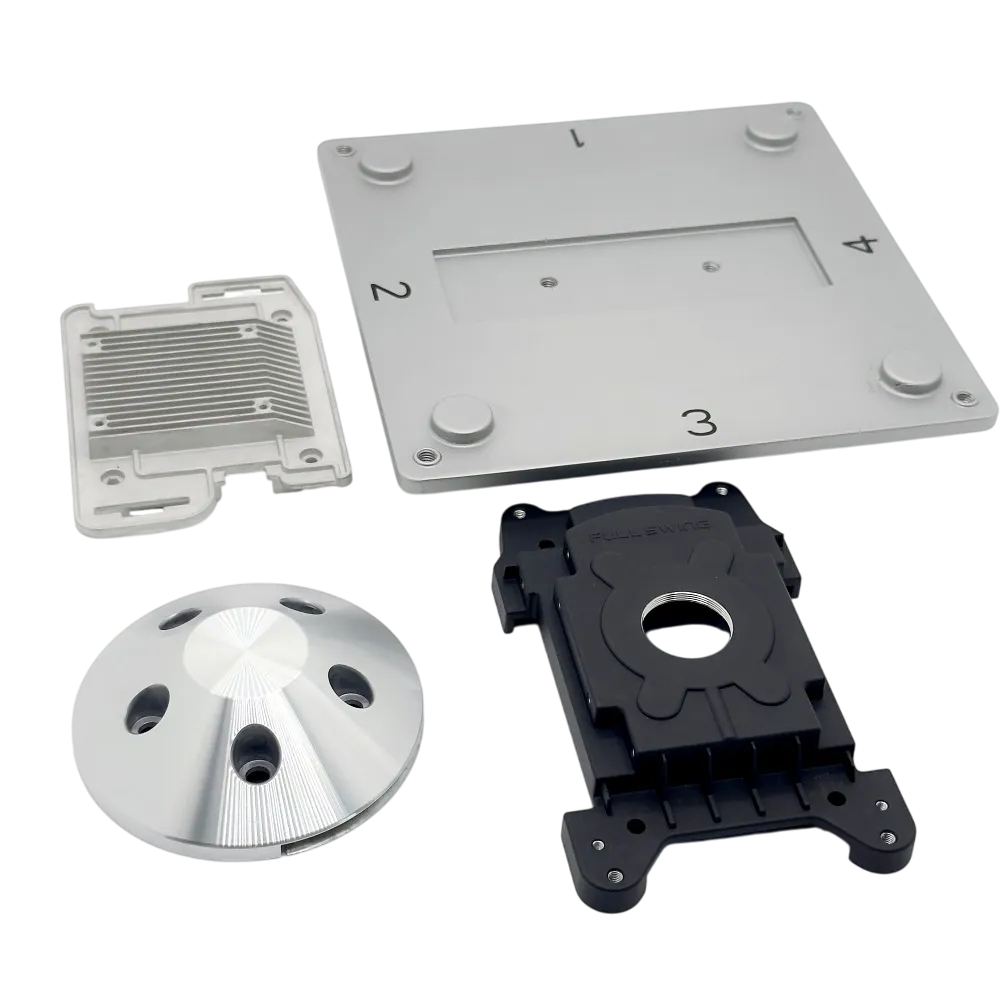
die casting vs cnc machining is one of the most important comparisons in modern manufacturing when selecting the right process for producing precision metal components. Each method offers distinct advantages in terms of cost, accuracy, material usage, production speed, and design complexity.
At SUNPREC, both Die Casting and CNC Machining are core manufacturing capabilities, allowing customers to choose the most suitable solution based on product requirements, volume, and performance expectations.
Understanding Die Casting and CNC Machining
Die Casting is a forming process where molten metal is injected into a steel mold under high pressure to create complex shapes with high repeatability. It is best suited for high-volume production of non-ferrous metals such as aluminum, zinc, and magnesium.
CNC Machining, on the other hand, is a subtractive manufacturing process where material is removed from a solid block using computer-controlled cutting tools. It is highly flexible and suitable for both prototyping and low-to-medium volume production with extremely tight tolerances.
Key Differences Between Die Casting and CNC Machining
The main difference between Die Casting and CNC Machining lies in how the part is created.
Die Casting is more efficient for mass production because once the mold is made, thousands of identical parts can be produced quickly and at low unit cost. However, it requires higher initial tooling investment.
CNC Machining does not require molds, making it ideal for prototypes, custom parts, and small batches. It offers greater flexibility for design changes but typically has higher cost per unit in large volumes.
At SUNPREC, both processes are optimized to deliver high precision and consistent quality depending on production needs.
Precision and Tolerance Comparison
CNC Machining generally provides higher dimensional accuracy and tighter tolerances, often reaching ±0.01mm or better depending on the part geometry and material.
Die Casting also offers good precision, but tolerances are influenced by cooling shrinkage, mold design, and material behavior. Post-processing such as CNC Machining is often used to achieve critical dimensions in Die Casting components.
SUNPREC frequently combines both processes, using Die Casting for near-net-shape production and CNC Machining for precision finishing.
Material and Design Flexibility
CNC Machining supports a wide range of materials, including aluminum, steel, brass, titanium, and engineering plastics. This makes it highly versatile for different engineering applications.
Die Casting is mainly limited to non-ferrous metals such as aluminum, zinc, and magnesium alloys. However, it excels in producing complex geometries with thin walls and integrated structures.
SUNPREC helps customers evaluate material selection based on strength, weight, corrosion resistance, and cost efficiency.
Production Efficiency and Cost Considerations
Die Casting is highly cost-effective for large-scale production because of its fast cycle times and low per-unit cost after tooling is completed.
CNC Machining is more economical for small batches or prototypes since it does not require expensive molds, but machining time increases cost in large-volume production.
SUNPREC provides engineering consultation to help customers balance upfront tooling investment with long-term production efficiency.
Surface Quality and Post-Processing
Die Casting typically produces parts with good surface finish, but additional processes such as machining, polishing, or coating are often required for final specifications.
CNC Machining provides excellent surface finish directly from the cutting process, though finishing treatments like anodizing or polishing may still be applied depending on application requirements.
SUNPREC integrates surface finishing services for both processes, including anodizing, powder coating, and electroplating, ensuring high-quality final products.
Application Scenarios
Die Casting is widely used in automotive components, electronic housings, heat sinks, and industrial structural parts where high-volume production is required.
CNC Machining is commonly used for precision parts in aerospace, medical devices, robotics, and custom industrial equipment where tight tolerances and design flexibility are essential.
SUNPREC supports both application types, offering end-to-end manufacturing solutions for diverse industries.
When to Choose Die Casting or CNC Machining
Choosing between Die Casting and CNC Machining depends on several factors:
If the project requires high-volume production with consistent geometry, Die Casting is the better option. If the project requires prototypes, complex design changes, or very tight tolerances, CNC Machining is more suitable.
In many cases, a hybrid approach is used, where Die Casting produces the base structure and CNC Machining refines critical features.
SUNPREC Integrated Manufacturing Advantage
SUNPREC stands out by offering both Die Casting and CNC Machining under one manufacturing system. This integration allows seamless transitions between processes, reducing lead time and improving product consistency.
From design optimization and prototyping to mass production and surface finishing, SUNPREC provides a complete solution for precision metal manufacturing.
Conclusion
Die Casting and CNC Machining are not competing technologies but complementary manufacturing solutions. Each has its own strengths depending on design complexity, production volume, and precision requirements.
SUNPREC leverages both processes to deliver optimized, high-quality, and cost-effective solutions for global industrial clients, ensuring every component meets strict engineering and performance standards.